
We've all been there.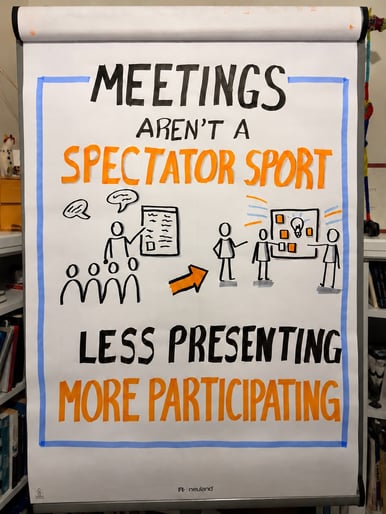
You're sitting in a meeting, watching someone work through a slide deck. There's a lot of information, a few questions, and perhaps some discussion at the end.
But how much actual thinking is happening in the room?
How many people are contributing? Are we building on each other's ideas, or simply taking turns talking?
And when everyone leaves, do we have a shared understanding of what we've decided and what happens next?
Meetings shouldn't be a spectator sport.
Yet so often, that's exactly what they become.
The good news? A few small changes to how we facilitate conversations can make a big difference. And one of the most effective tools we have is surprisingly simple: making our thinking visible.
From presenting information to creating understanding
There's nothing inherently wrong with presentations. Sometimes we need to share information, explain a process, or bring people up to speed.
But sharing information and creating understanding aren't quite the same thing.
Think about the difference between showing a team a completed strategy document and inviting them to help build a visual representation of that strategy.
In the first scenario, they're receiving information.
In the second, they're actively making sense of it.
They're identifying connections, asking questions, challenging assumptions, and contributing their perspectives.
And importantly, everyone can see the conversation taking shape.
That's where visual thinking becomes incredibly valuable.
What happens when we put ideas on the wall?
Imagine you're facilitating a meeting about improving the customer experience.
You could ask everyone to share their thoughts, take notes, and circulate a summary afterward.
Or you could start with a large sheet of paper and a simple question:
What does our customer's journey actually look like?
As people contribute, you begin mapping the experience together.
A few simple icons represent the customer, the different touchpoints, and the challenges they encounter. Arrows connect the steps. Speech bubbles capture questions. Colours help distinguish what works from what needs attention.
Before long, something interesting happens.
People begin responding to what they can see.
"Wait, we're missing a step."
"That's where our customers tend to get frustrated."
"What happens between these two stages?"
"Could we approach that differently?"
The visual becomes a shared reference point for the conversation.
Instead of everyone holding a slightly different picture in their heads, the group has something concrete to explore, question, and improve.
And here's the important part: You don't need to be an artist to make this happen.
Visual thinking isn't about creating beautiful drawings
This is probably one of the biggest misconceptions I encounter when talking about visual thinking.
People assume they need artistic talent.
They imagine elaborate illustrations, perfectly drawn people, or beautifully designed posters.
But the real value of visual thinking isn't in the artwork. It's in what the drawing helps people understand.
A stick figure can represent a customer.
A few boxes and arrows can explain a complicated process.
A simple symbol can communicate an idea faster than a paragraph of text.
It's about having a practical visual vocabulary that helps us express ideas and make connections.
That's one of the things I love about bikablo®, the visual language and training methodology I teach.
It gives people a structured, accessible way to communicate visually, even if they haven't picked up a marker since school.
And once people discover that they can draw well enough to communicate, something shifts.
They become more willing to experiment, contribute, and use visuals in their everyday work.
Five ways to make your next meeting more participatory
You don't need to redesign your entire meeting process to get started.
Here are five simple things you can try.
1. Start with a question, not a slide
Instead of opening with ten slides explaining the problem, put one meaningful question on the wall.
What's getting in our way?
What would success look like?
Where are we losing momentum?
Give people a moment to think, then invite them to contribute.
2. Make contributions visible
Capture ideas where everyone can see them.
Use sticky notes, simple drawings, keywords, or a combination of all three.
The goal isn't to create a perfect record of everything said. It's to help the group see the important ideas emerging.
3. Look for connections
As ideas accumulate, start organizing them.
Which ideas belong together? Where are the gaps? Are there recurring themes?
Circles, arrows, colours, and simple containers can help people recognize patterns that might otherwise get lost in conversation.
4. Invite people to interact with the visual
Don't let the drawing become another presentation that everyone watches you create.
Ask people to add ideas, move sticky notes, connect concepts, or challenge what's on the wall.
The magic isn't in watching someone draw.
It's in thinking together.
5. Finish with something everyone can see
Before the meeting ends, step back and look at what you've created.
What have we agreed on?
What's still unresolved?
What are the next steps, and who's responsible?
A photograph of the completed visual can provide a useful reminder of the discussion and decisions.
Just remember that the visual is a tool for clarity, not a replacement for documenting important decisions and responsibilities.
A different way of working together
I've spent many years working with organizations on marketing, sales processes, customer journeys, and business strategy.
One thing I've learned is that a lot of business challenges aren't caused by a lack of ideas.
Sometimes the challenge is that those ideas are scattered across different people, departments, documents, and conversations.
People may be working toward the same goal without necessarily sharing the same understanding of how to get there.
Visual thinking offers a way to bring those perspectives together.
It helps us slow down, see the bigger picture, identify what matters, and move toward action.
And it can make the process a lot more engaging along the way.
Ready to get visual?
As a member of the bikablo Global Training Team and a trainer here in Canada, I'm excited to help more people discover how accessible and useful visual communication can be.
In February 2027, I'll be delivering two-day bikablo basics workshops in:
- Halifax: February 10–11, 2027
- Toronto: February 17–18, 2027
These hands-on workshops introduce the foundational techniques of visual communication, from simple symbols and figures to layouts you can use in meetings, workshops, presentations, and everyday business conversations.
No artistic experience required.
Just a willingness to pick up a marker and try something new.
Because the best meetings aren't the ones where everyone watches. They're the ones where everyone contributes.
Topics: bikablo