
How to put visual thinking to work in your everyday meetings.
You've probably seen it at a conference, workshop or corporate event. Off to one side of the room, someone is working away at a large sheet of paper, transforming a presentation or conversation into an impressive visual record. As the event unfolds, the wall fills with colourful drawings, keywords, connecting lines and illustrations that somehow bring everything together.
It's fascinating to watch. And when it's done well, it's a remarkable skill.
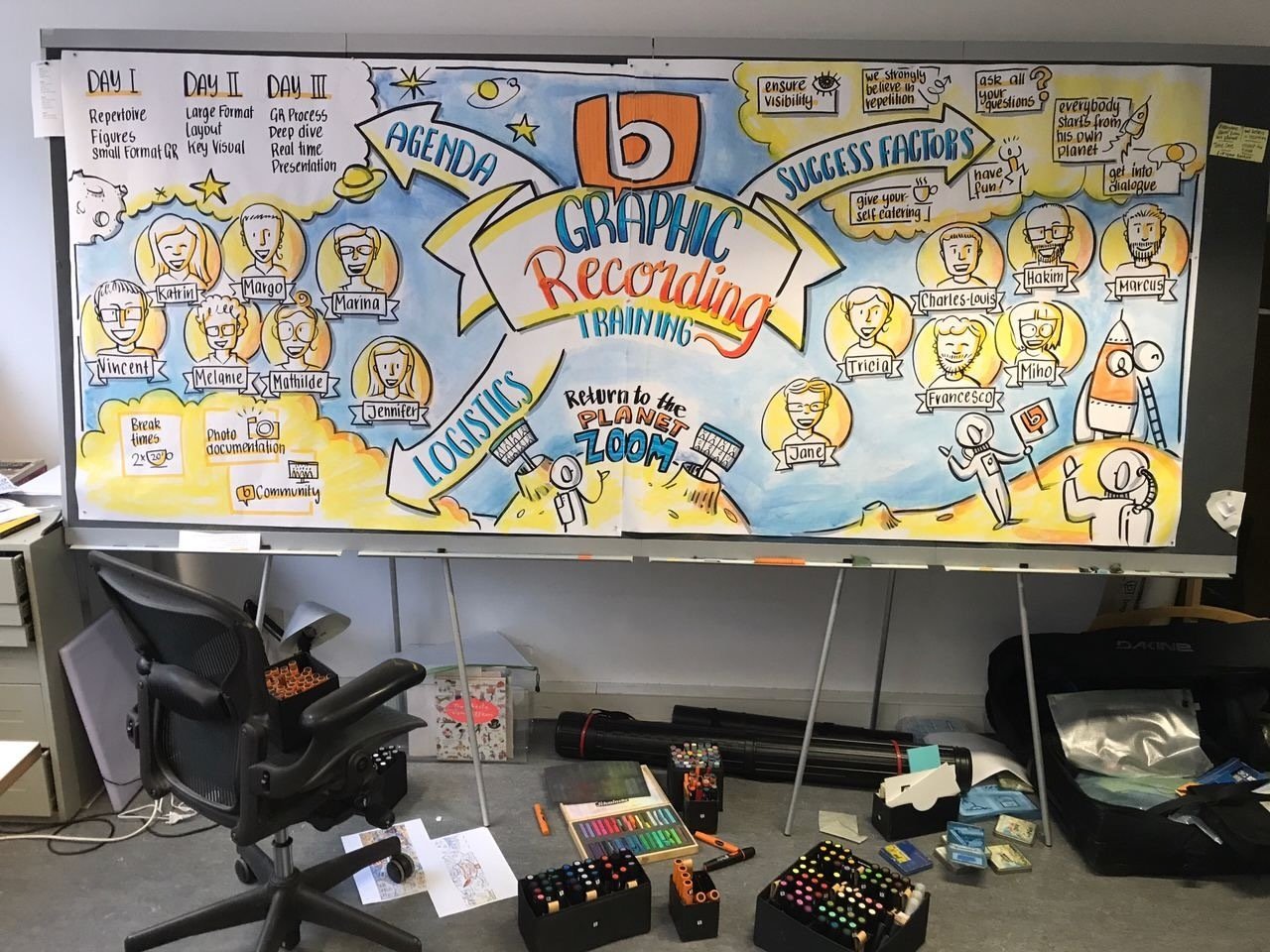
Photo: A graphic recording created by Stefan Böker during a training I attended in 2019. Seven years later, it remains a wonderful visual reminder of the people, ideas and learning we shared. Used with permission.
Graphic recording brings together deep listening, the ability to synthesize information and visual storytelling. A talented graphic recorder can capture the essence of a conversation in a way that makes it memorable, accessible and easier to revisit long after everyone has left the room.
But here's something worth considering: What if visual thinking wasn't something you only experienced when a professional graphic recorder was in the room? What if you could put some of those same visual principles to work in your own meetings, conversations and planning sessions?
That's where graphic facilitation and everyday visual thinking open up some exciting possibilities.
From recording the conversation to helping shape it
Graphic recording and graphic facilitation share many of the same visual tools, but they can play different roles.
Graphic recording often focuses on capturing and synthesizing what is being shared. The resulting visual becomes a record of the conversation, helping people reflect on the experience, reinforce their learning and communicate key messages to others.
Graphic facilitation brings visuals directly into the process of working together. Rather than simply documenting what people are saying, we use drawings, diagrams, symbols and visual structures to help people explore ideas, identify connections, work through challenges and build a shared understanding.
The distinction isn't always clear-cut. A skilled graphic recorder may help a group see new connections, and a graphic facilitator may create a valuable visual record along the way. Both approaches have tremendous value.
But graphic facilitation introduces an opportunity that I find particularly exciting: making visual thinking part of how people work together, rather than something they simply observe.
What could visual thinking do for your next meeting?
Think about the meetings you attend or facilitate. How often does someone explain a complicated process while everyone else tries to hold the details in their heads? How often do people leave a discussion believing they've reached an agreement, only to discover later that they had very different interpretations of what was decided?
We rely heavily on spoken and written language in our workplaces, but words alone don't always help us see the whole picture.
Visual thinking gives us another way to work through information together. And it doesn't have to be complicated.
Mapping a process. Imagine a team trying to understand why a customer onboarding process isn't working as smoothly as it should. Instead of talking through each step, they draw the process on a wall. Suddenly, the handoffs become visible. So do the bottlenecks, duplicated efforts and missing pieces. People can point to a specific step, question it and suggest improvements.
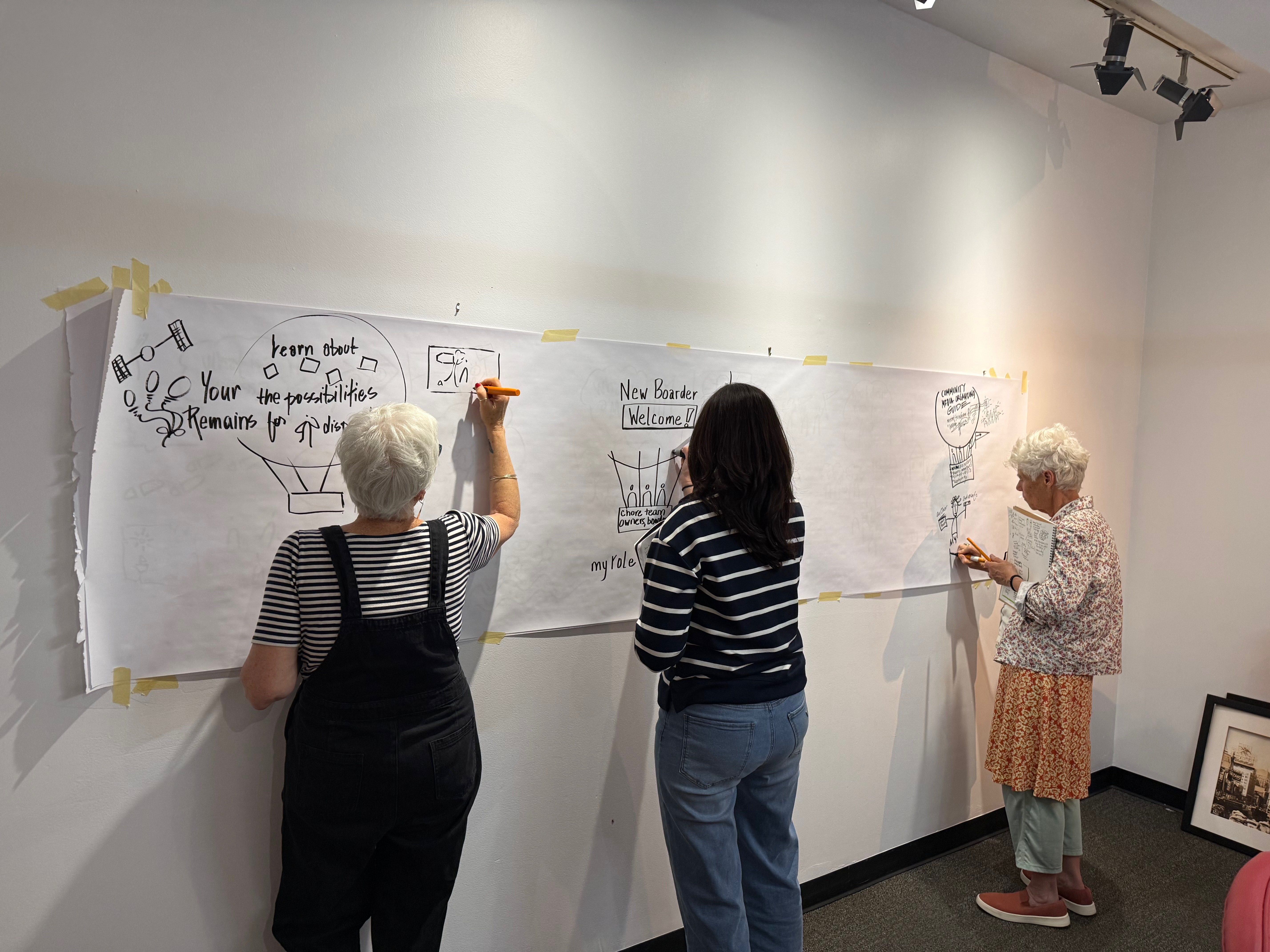
Exploring a problem. When a team is struggling with a challenge, a simple visual map can help organize different perspectives, identify contributing factors and uncover relationships that might otherwise be missed.
Planning a project. Rather than starting with a long list of tasks, a team can use a visual structure to explore goals, priorities, dependencies and responsibilities. Everyone can see how their work connects to the bigger picture.
Facilitating a discussion. Simple drawings, symbols and visual templates can help invite contributions, organize ideas and make it easier for quieter participants to engage. The visual becomes something everyone can work with, question and build upon.
None of these activities requires a masterpiece. What matters is that the visuals help people think more clearly and work together more effectively.
But I'm not artistic!
This is probably the most common reaction I hear when I introduce people to visual thinking.
And I understand why. When we see the work of an accomplished graphic recorder, it's easy to conclude that this sort of communication is reserved for people with artistic talent.
But here's the good news: You don't need to draw beautifully to communicate visually.
A few simple figures, arrows, containers, symbols and keywords can go a surprisingly long way. A stick figure can represent a customer. A series of boxes can illustrate a process. A winding road can help a team explore a journey, complete with obstacles, milestones and opportunities.
The goal isn't to create art. It's to make information visible so people can work with it. If you've ever caught yourself saying, "I can't draw," I've explored why that doesn't matter nearly as much as you might think in “I Can't Draw!” And Why That Doesn't Matter.
This is one of the things I particularly appreciate about the bikablo® approach. It offers a structured, accessible way to learn a visual vocabulary that can be applied to everyday business communication. Rather than starting with artistic technique, we build confidence with simple shapes, visual structures, lettering and symbols that anyone can learn to use.
Over time, those basic elements become tools for explaining ideas, facilitating conversations and helping groups navigate complexity.
And perhaps most importantly, people begin to see that visual communication is a skill they can develop, not a talent they either have or don't have.
The magic happens when people participate
In my previous article, Meetings Aren't a Spectator Sport: Less Presenting, More Participating, I explored the value of getting people actively involved in meetings rather than simply asking them to sit and listen. Visual thinking is one practical way to make that happen.
When ideas move out of our heads and onto a shared surface, they become easier to examine, challenge and build upon. The person holding the marker doesn't need to have all the answers. Sometimes the most useful thing they can do is draw a simple structure and invite others to contribute. What's missing? How are these ideas connected? What might a better process look like?
As the visual evolves, so does the conversation. People can see how their contributions fit into the bigger picture, question assumptions and develop a shared understanding. And because they've helped shape the thinking, they're more likely to feel ownership of what happens next.
That's where I believe visual facilitation can make a real difference—not simply making meetings more engaging, but helping people work toward better outcomes together.
Making visual thinking part of everyday work
Not every meeting needs a professional graphic recorder or graphic facilitator, although there are certainly situations where their expertise can make an enormous difference. But imagine if more of us felt confident using simple visual techniques in our everyday work.
A team leader sketching out a problem on a flip chart. A sales team mapping the customer journey together. A project manager using a visual structure to clarify responsibilities. Or a facilitator inviting participants to build a picture of their collective thinking rather than simply responding to presentation slides.
These aren't extraordinary applications. They're practical ways to improve communication, collaboration and the quality of our conversations. And developing the confidence to use them doesn't require artistic talent, just a willingness to learn and practise.
The next time you're preparing for a meeting, perhaps the question shouldn't just be, "What am I going to tell people?"
Maybe it should be, "What could we figure out together if we could see what we're thinking?"
Ready to put visual thinking to work?
As Canada's bikablo® trainer, I'm excited to help more people discover how accessible and practical visual communication can be.
Our two-day bikablo basics training introduces a visual vocabulary and a range of techniques you can put to work in meetings, workshops, presentations and everyday conversations.
You don't need artistic experience. Just curiosity, an open mind and a willingness to pick up a marker.
Upcoming training:
- Halifax: February 10–11, 2027
- Toronto: February 17–18, 2027
Topics: bikablo, Visual Thinking