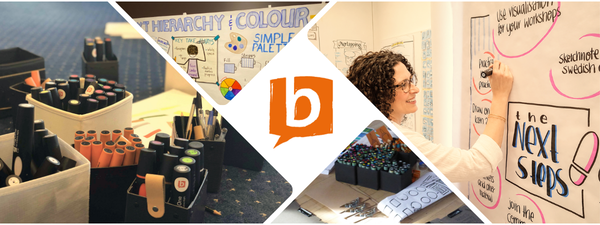
My Journey to Becoming a bikablo Trainer
In 2018, I attended a Graphic Facilitation course at The Grove, and honestly, it changed the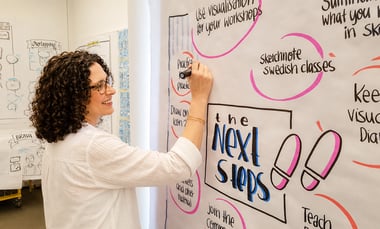 way I think about communication.
At the time, I was already deeply involved in strategy, marketing, training, and facilitation work through More in Store Marketing Solutions. Like many people, I had spent years sitting in meetings, workshops, and planning sessions where important ideas were discussed… but not always truly understood, remembered, or retained.
The course opened the door to the world of visual communication for me, and I immediately saw the potential. I loved what I was learning. But at the same time, I felt like something was missing.
I am not an artist.
And while I could see the power of visual facilitation, I often found myself wondering:
“How do I actually build a visual language I can use confidently?”
I felt like I was missing a foundational piece — a practical visual vocabulary.
Around that time, I discovered bikablo’s icon sets and books, and suddenly something clicked for me.
When we learn to speak, we first learn vocabulary. We don’t invent every word from scratch — we learn patterns, structures, and reusable building blocks that help us communicate ideas clearly.
I realized that was exactly what I had been searching for visually.
I didn’t need to become an illustrator.
I needed a visual vocabulary.
The bikablo approach gave me that missing foundation. Instead of trying to figure out how to draw everything from scratch, I began learning a practical system of simple icons, shapes, containers, typography, connectors, and visual structures that could be combined to communicate ideas clearly and confidently.
That discovery eventually led me to bikablo Basics — and honestly, it was the foundational piece I had been missing all along.
What stood out to me immediately was how accessible the approach felt. This was not about creating perfect artwork. It was about helping people think, communicate, collaborate, and remember information more effectively through visuals.
Over the years, I continued learning and began incorporating visual thinking into my own work. I started using simple visuals in workshops, strategy sessions, planning meetings, process mapping, and training environments.
The impact was immediate.
People leaned in more.
Ideas became clearer.
Conversations slowed down in a good way.
And most importantly, people remembered more.
There is powerful research behind why visual communication works so well. Studies have shown that people process visuals significantly faster than text, and that combining words with visuals dramatically improves comprehension and retention. Some research suggests people remember only about 10–20% of spoken information after a few days, but when information is paired with relevant visuals, retention increases dramatically.
In today’s world, we are constantly overwhelmed with information, notifications, presentations, and fast-moving conversations. Visual communication creates something different. It encourages us to slow down, listen carefully, identify what matters most, and make ideas visible in real time.
There is also something incredibly human about creating visuals live in a room.
When people watch ideas take shape visually during a meeting or workshop, the energy changes. Participants become more engaged. Complex ideas become more approachable. Connections become easier to see. The process creates shared understanding in a way that traditional note-taking or slide presentations often cannot.
One of the things I love most about the bikablo Method is that it removes the intimidation factor so many people feel around drawing. The approach is specifically designed for non-artists.
You do not need artistic talent to communicate visually.
You simply need a system.
Through simple shapes, structures, icons, typography, and visual frameworks, almost anyone can learn to think and communicate visually.
And that matters because visual thinking is no longer just for designers or illustrators.
It is becoming an increasingly valuable skill for:
- facilitators
- consultants
- educators
- leaders
- marketers
- project teams
- trainers
- innovation teams
- and organizations looking for better ways to communicate and collaborate
I’m incredibly excited to now be bringing bikablo training to Canada and introducing more individuals and organizations to this powerful approach.
Recently, I completed the bikablo Train the Trainer program and joined the Bikablo Global Training Team for Canada. It feels like a full-circle moment from that first course in 2018 to now helping others discover the same confidence and clarity that visual communication has brought to my own work.
This is just the beginning, and I look forward to sharing more about upcoming workshops, training opportunities, and the role visual communication can play in helping teams and organizations think more clearly, collaborate more effectively, and make ideas stick.
And if you are reading this thinking:
“But I can’t draw…”
You are exactly the kind of person bikablo was designed for.
We have several sessions lined up for this summer...
July 29 & 30, Annapolis Valley Chamber of Commerce
August 12 & 13, Luminate Co Wellness Studio, Bedford
August 17 & 18 Center for Social Innovation
View all our training sessions here or learn more about bikablo here
Stay tuned, I am working on training details now for courses in Ottawa and Edmonton. Sign up for my newsletter (in the footer below) to ensure you are up to date on the latest offerings.